UK Sleep Guide
Choosing an Organic Sleep Surface: Materials, Certifications and Care
The word “organic” can make a mattress sound less like a complicated assembly of layers and more like a promise. But it is not one promise, and it does not mean every part of a bed has been grown, processed or made in the same way. For shoppers, the useful work lies in the details: what each layer contains, what a certification actually covers, and how the mattress should be looked after once it comes home.
Natural fibres and latex can make appealing components in a sleep surface, but materials alone do not settle questions of comfort, durability or environmental impact. A calm, informed purchase begins with the specification, not the adjective on the label.
What does “organic mattress” mean?
There is no single construction shared by all organic mattresses. One may use organic cotton in its cover, wool as a comfort or insulating layer, and natural latex in its core. Another may combine some of those materials with steel springs, adhesives, or components whose origins are described differently. The phrase is therefore best treated as an invitation to investigate, not as a complete specification.
Start by asking which components are claimed to be organic. Does the claim refer to the cover alone, the filling, the latex, or a stated proportion of the finished mattress? Is it supported by a certification, and can the seller identify the exact product or material covered? A product page that says “made with organic materials” may be accurate while still leaving much of the construction unexplained.
It helps to distinguish three questions that advertising often folds into one. First: what is the material? Second: how was it grown or processed? Third: what qualities does it bring to the mattress? A cotton cover may be organic without the entire mattress being certified organic. Wool may be natural without being certified organic. Latex may be described as natural, but the word alone does not tell you its full composition or the standard used to substantiate the claim.
That distinction is not a reason for suspicion. It is simply a way to read claims with care. In a well-described mattress, the seller should be able to explain the layers in plain language and distinguish certified components from those that are not.
The materials beneath the cover
Cotton: a familiar surface with a complicated story
Cotton is often used in mattress covers and quilted layers because it is soft, familiar and capable of absorbing moisture. Organic cotton refers to cotton produced under an organic agricultural standard; the term does not, by itself, tell you how the fibre was spun, dyed, woven or assembled into a finished mattress. Those later stages can be addressed by other standards, depending on the product and the certification scheme.
For a shopper, the practical questions are modest but revealing: Is the cotton in the cover, the batting, or both? Is the material certified? Is the cover removable, and if so, is it intended to be washed? A natural fibre is not automatically washable, and a removable cover is not necessarily a licence to put the whole mattress in a washing machine.
Wool: warmth, loft and moisture management
Wool may appear as a batting or comfort layer, sometimes alongside cotton or other fibres. Its structure can help create loft and a springy feel, while the fibre’s ability to interact with moisture and air contributes to its use in bedding. The precise performance depends on the amount of wool, how it is prepared, how it is held in place and what surrounds it.
Descriptions such as “natural,” “British wool” or “traceable wool” tell different stories and should not be treated as interchangeable with organic certification. If a particular standard matters to you, look for its name and scope, rather than relying on a general materials description. Also check the care instructions: wool-filled mattresses and toppers often need careful spot cleaning and thorough drying, not routine machine washing.
Natural latex: ask what “natural” refers to
Latex used in mattresses can be made from rubber-tree sap, synthetic materials, or blends. A listing that says “natural latex” should ideally state the type of latex and identify any relevant certification. “Dunlop” describes a manufacturing process, not an organic certification. “Organic” is a separate claim about agricultural production and must be supported by evidence appropriate to that claim.
Latex can provide a responsive, buoyant feel that differs from the slower contouring commonly associated with memory foam. Yet feel is a matter of construction and preference: thickness, firmness, the layers above it, and the support core all influence the experience. No material label can tell a sleeper in advance whether a particular mattress will suit their body, sleeping position or temperature preferences.
Springs, fabrics and the less visible parts
An organic or natural-material mattress may still include a steel spring unit. Springs are not a fibre, but they can be central to the support system, and the way they are arranged affects movement, edge support and overall feel. Pocket springs, for example, are enclosed individually so that they can respond more independently than a connected spring system. That construction does not establish anything about the organic status of the mattress’s other layers.
Thread, stitching, fire barriers, adhesives and edge components may also form part of a mattress. Ask the manufacturer for a layer-by-layer description if these details matter to your decision. It is reasonable for a seller not to publish every manufacturing secret; it is also reasonable for a buyer to want clear information about the materials and claims being made.
Reading mattress certifications without getting lost
Certification labels can make a complex supply chain easier to understand, but each one has a defined scope. A certificate may concern the agricultural origin of a fibre, the processing of a textile, restrictions on certain substances, or the chain of custody for a material. It does not necessarily certify every component of a finished mattress, nor does it automatically establish that the mattress is the most comfortable, durable or environmentally preferable choice.
GOTS, the Global Organic Textile Standard, is associated with organic fibres and processing requirements for textiles. When a mattress seller cites GOTS, check whether the certificate applies to a fabric or component, or to a broader product claim, and whether the documentation is current and relevant to the item being sold. GOLS, the Global Organic Latex Standard, is a standard to look for when a seller makes a claim about certified organic latex. Again, verify what material and product the documentation covers.
Other labels may address chemical testing or material safety rather than organic agriculture. OEKO-TEX® STANDARD 100, for example, is a textile testing label with a focus on harmful substances in tested articles. It is not the same thing as proof that a fibre was grown organically. This does not make one label better than another; it means they answer different questions.
Certification names are sometimes used loosely in product descriptions. A careful shopper can ask for the certificate number, the certifying body, the certified product or component, and the date or validity period. If the seller cannot provide all of that immediately, a clear explanation of what is certified and where to find supporting documentation is still useful.
- Identify the claim: Is it about organic cotton, organic latex, low emissions, chemical testing, or something else?
- Check the scope: Does the certificate cover the raw material, a textile, a component, or the complete mattress?
- Match the paperwork to the product: Confirm that the named material and product correspond to the mattress you are considering.
- Separate safety from origin: A label about tested substances is not necessarily a label about organic farming.
- Look beyond the badge: Read the full specification, warranty, care directions and returns policy.
For UK shoppers, the country of sale does not make international certification claims self-explanatory. A retailer may sell a product made elsewhere and certified under a scheme used across borders. The useful standard is not that every label be British; it is that the claim be specific, verifiable and accurately described.
Comfort is a construction, not a certificate
Certification can help a shopper understand sourcing or processing, but it cannot choose firmness. The sensation of a mattress emerges from the whole assembly: the spring unit or foam core, the comfort layers, the cover, the thickness of each material and the interaction between them. A latex layer over coils will not necessarily feel like a solid latex mattress. Wool quilting can soften the surface without making the support core softer in the same way.
If possible, try the mattress in a position that resembles the way you sleep, and allow enough time to notice pressure at the shoulders, hips and lower back. For an online purchase, read the trial and return terms closely. Check who pays for collection, whether there is a minimum trial period, and whether a refund is subject to conditions. These details can matter as much as a material comparison when the mattress has not been tried at home.
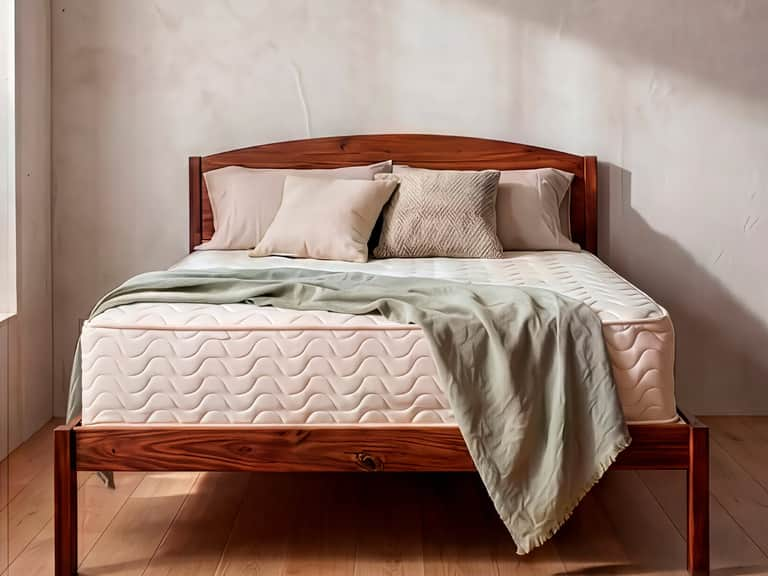
One example of a layered approach is the Latex & Comfort Coil Mattress, described as combining organic Dunlop latex with a coil core, organic cotton and Eco-Wool. Its stated materials make it relevant to shoppers comparing natural latex and spring constructions. As with any product, the name and description are a starting point: review the full specification and verify any certification claim directly before treating it as proof about the entire mattress.
A practical buying checklist
Mattress shopping tends to invite grand language. A checklist brings the conversation back to the bed itself.
- Request a layer breakdown. Find out what sits in the cover, comfort layer, support core and base.
- Ask for percentages where possible. Blended materials and mixed constructions are common; proportions help explain what “made with” means.
- Confirm certification scope. Ask which exact component or finished product is covered and how the claim can be checked.
- Compare like with like. A thin latex comfort layer is not equivalent to a mattress made largely from latex.
- Consider the bed base. A mattress may require a particular type of support, spacing or ventilation. Follow the manufacturer’s requirements to avoid affecting performance or warranty coverage.
- Review delivery and returns. Check the trial period, collection arrangements, fees and how the mattress must be kept during the trial.
- Read the warranty carefully. Note what is covered, what counts as a defect, and any requirements about the base or maintenance.
- Be cautious with absolutes. Claims such as “chemical-free,” “non-toxic” or “perfect for everyone” need unusually clear definitions and evidence.
These questions are not a test of the seller’s patience. They are a way to establish whether the product description is precise enough for an informed decision. A transparent answer may be brief; what matters is that it distinguishes materials, performance, certification and care rather than presenting them as a single virtue.
Care begins with the instructions
A mattress is not a garment, even when it contains cotton or wool. Most cannot be washed, and soaking them can damage fibres, adhesives, quilting or the support unit. Begin with the care label and manufacturer’s guidance. For routine upkeep, a fitted sheet and a washable protector can help limit perspiration, dust and accidental spills from reaching the mattress. Choose a protector that fits the mattress depth and does not interfere with the feel you want.
Air the room regularly and allow the bed to ventilate when practical. If a spill occurs, act promptly: blot rather than scrub, use only cleaning methods recommended by the manufacturer, and let the area dry thoroughly before remaking the bed. Heat, excess moisture and harsh detergents may damage materials or leave residues. Do not assume that a “natural” filling is immune to stains or odours.
Rotation and turning are not universal instructions. Some mattresses are designed to be rotated head to foot; others are one-sided and should not be flipped. Follow the maker’s direction, because turning a mattress that has a designated top and bottom can change the intended layering. Check the bed base occasionally as well: a sagging or unsuitable foundation can affect support and may complicate a warranty claim.
For wool and latex in particular, gentle handling and dryness matter. A wool layer may compress with use, while latex should be protected from prolonged exposure to direct sunlight if the manufacturer advises it. These are not reasons to expect fragile bedding; they are reminders that a mattress is a layered object with different materials and different needs.
What a responsible claim sounds like
Good product information is often less theatrical than advertising. It names the material, says where it appears, clarifies whether it is certified, and provides a route to further evidence. It does not imply that a single label guarantees perfect sleep, the absence of every synthetic component, or a particular environmental outcome across the product’s whole life.
For consumers, that measured language can be reassuring. An organic mattress may be a meaningful choice for someone who values particular agricultural standards or natural fibres. Another shopper may prioritise firmness, a manageable price, a long trial period, or a support system that suits their body. Those priorities can coexist, but they should not be made to compete through vague claims.
The most useful purchase is rarely the one with the most impressive vocabulary. It is the one whose materials you can identify, whose certifications you can interpret, whose construction suits your needs, and whose care requirements you are willing to follow. In the quiet business of choosing a bed, clarity is a comfort in its own right.
Frequently asked questions
Does “organic mattress” mean every part is organic?
Not necessarily. The claim may refer to one or more materials, such as cotton or latex, rather than the complete mattress. Ask for a layer breakdown and check exactly what any certificate covers.
Is natural latex the same as organic latex?
No. “Natural” describes an asserted material origin, while “organic” is a separate claim that should be supported by an appropriate standard and documentation. Ask the seller to define the terms used.
Does a certification guarantee comfort or durability?
No. A certification has a defined scope, such as material sourcing or testing. Comfort and durability depend on the entire construction, use, care, and the sleeper’s preferences.
Can I clean an organic mattress at home?
Follow the manufacturer’s instructions. Many mattresses should only be spot-cleaned, if cleaning is advised at all. Use a washable protector and dry any treated area fully before putting bedding back on.